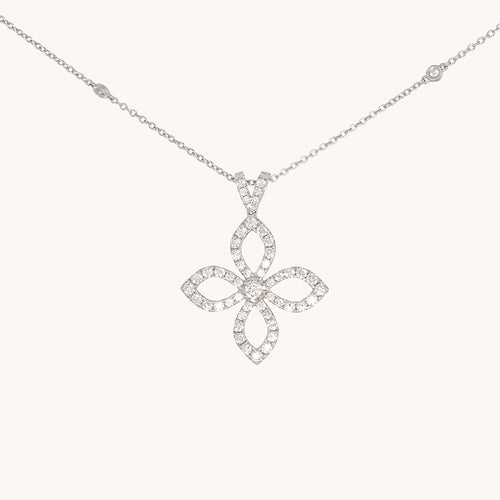


The choice of pendant setting will depend on what the wearer prioritizes. For example, they may want a stone that is secured well, or perhaps the sparkle of the stone is of most importance.
Each setting offers its pros and cons, so read on to discover how each one presents the gemstone before making a choice for your next pendant purchase.
Prong setting
This traditional style uses small claws, or prongs as the name suggests, to keep the gemstone secure. There may be six prongs, or four as with the Emerald Solitaire Pendant from Mera which holds a single round-cut emerald.
Each prong is strategically placed to cradle the stone in a way that maximizes its brilliance. Additionally, this setting is particularly easy to clean, which makes such pendants a durable addition to any collection.

Bezel setting
With the bezel setting, a metal rim will encase the stone in its entirety. The design is both secure and modern in its appearance, making it durable for those wanting peace of mind with a stone of high value.
This technique has been around for a long time, and has developed into two variations; the full bezel and the partial or semi-bezel. The full bezel wraps around the stone to protect it from damage, while the partial bezel leaves it more exposed for additional sparkle.
Halo setting
To make the center stone look larger, the halo setting will frame a ring of smaller gems as accents around it. This layout also makes the pendant sparkle more and results in an eye-catching piece.
The accents are often set in a pave style, and the setting type is typically traditional prongs or a bezel setting.
Examples of this setting include the Timeless Diamonds emerald heart pendant from Mera, which features a halo of round brilliant stones around a vivid green gemstone. Similarly, the Emerald and Diamond Heart Pendant showcases a central stone surrounded by elegant white accents.
Channel setting
Pendants with this setting feature gems which are set alongside each other with two walls of metal between them. As a result, channel set jewelry is ideal for everyday wear as the stones are highly secure and durable.
The only downside is that there is a reduced amount of light that can reach the stones, which means the brilliance level is lower compared with techniques such as prong or pave.
Pave setting
Tiny diamonds are set closely together with small prongs or beads, creating the pleasing illusion of a surface that is encrusted thoroughly with sparkling gems.
This setting is highly sought-after with luxury jewelry, as it provides the look of a piece which has been dipped in diamonds.
Keen to explore pave set pendants? The Forever In Love diamond heart pendant from Mera is encrusted with pave-set round brilliant diamonds. Elsewhere, the Gold Diamond Heart Pendant provides a trio of pave-set diamond-lined hearts nested within one another.

Flush setting
The flush setting involves a hole being drilled into the metal, followed by the gemstone being placed so that its top surface is flush with the surrounding material. It is then hammered down carefully to lock the stone securely in place.
The result is an extremely durable setting that is smooth thanks to the lack of prongs or bezels, which prevents the jewelry from snagging on clothing or other surfaces.
Invisible setting
An intriguing design where the stones are set without any visible metal, so it looks as if they are not held in place by anything and yet the wearer has a durable piece.
In fact, the technique involves a groove being cut along the edge of each stone before they are slid onto a hidden metal framework which secures them all in place. The process has been around since 1933 and requires a high level of skill to produce.
Peg setting
This setting is often overlooked but those who know it will most likely have a pearl pendant. The technique involves a single peg being screwed into the stone, as it has a curved appearance similar to a corkscrew to help with the process.
An industrial strength adhesive is then used to bind the peg, and a cup is often atop the peg to further secure the pendant. It is popular for those wanting the stone exposed to create a minimalist look.

Frequently asked questions
What setting makes a diamond sparkle most?
The recommended setting for a diamond with maximized sparkle is the prong setting, as it exposes the stone by holding it with minimal metal. As for the diamond itself, a round brilliant cut is the combination that will give you the highest level of shimmer.
What setting makes a diamond look the biggest?
A halo setting is ideal for making a diamond look the biggest, and it can be used with platinum or white gold metals to reflect the light and blend with the stone.
What are good pendant settings for loose stones?
A few good pendant settings for loose stones include prong settings to enhance sparkle level, as well as bezel settings if security is the priority.
What are pendant settings without stones?
Pendant settings without stones are called mountings or semi-mounts. These are the unfinished metal frames which will hold a stone once it has been added. There are numerous styles available, such as claws to hold a stone or metal collars to facilitate the bezel setting.